


Status: Resolved
Date: July 14, 2026
Customer impact: Approximately five minutes of service unavailability on the affected virtualization host
Summary
On July 14, 2026, DCX performed an emergency security update on one of its KVM virtualization hosts.
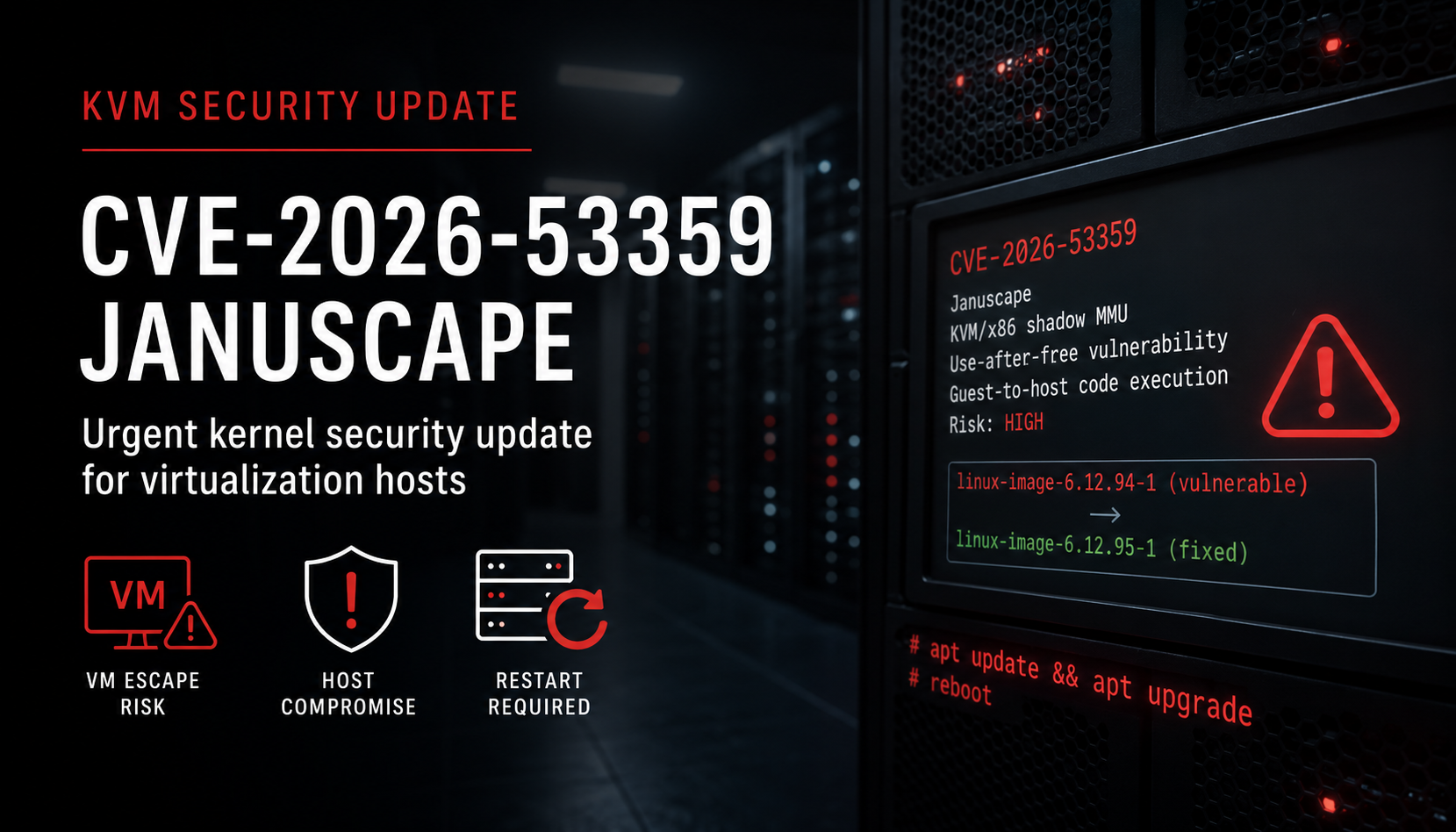
The update addressed CVE-2026-53359, also known as Januscape, a vulnerability in the Linux kernel KVM/x86 memory management subsystem. Activating the corrected kernel required a controlled restart of the physical virtualization host.
Workloads running on the affected host were temporarily unavailable during the restart. The host shutdown began at approximately 19:29 CEST and the system booted into the corrected kernel at approximately 19:34 CEST. Services returned as the normal startup and validation process completed.
The maintenance completed successfully.
We apologize for the disruption, including to customers who were actively working on their websites or applications at the time.
Customer impact
During the maintenance window:
- Virtual machines and websites running on the affected host were temporarily unavailable.
- The host-level interruption lasted approximately five minutes.
- No storage array became degraded.
- No filesystem corruption was detected.
- We found no evidence of data loss resulting from the restart.
- The host returned with all system RAID arrays healthy and no failed system services.
This was an emergency security maintenance event. It was not caused by hardware failure or an uncontrolled server crash.
Why the update was treated as urgent
Januscape is a use-after-free vulnerability in the KVM/x86 shadow memory management code used by Linux virtualization hosts.
The public proof of concept demonstrates that code running inside a suitably configured guest virtual machine can trigger a host kernel panic. The researcher also reports a separate guest-to-host code-execution exploit that has not been publicly released.
A successful attack against a shared virtualization host could affect not only the attacking virtual machine, but also the physical host and other workloads running on it.
Debian lists kernel package 6.12.94-1 as vulnerable and 6.12.95-1 as fixed for Debian 13. The corrected kernel does not protect a running host until the system has restarted and booted into that kernel.
Because the potential impact crosses the isolation boundary between a virtual machine and its physical host, we determined that postponing activation of the corrected kernel presented a greater risk than a short controlled interruption.
Technical references:
https://security-tracker.debian.org/tracker/CVE-2026-53359
https://github.com/V4bel/Januscape
https://git.kernel.org/linus/81ccda30b4e83d8f5cc4fd50503c44e3a33abfeb
Timeline
19:29 CEST
The controlled host restart began after the remaining virtualized workload was instructed to shut down.
19:29:37 CEST
System services were stopped, filesystems and block devices were synchronized, storage volumes were unmounted, and the operating system reached its reboot target.
19:34:08 CEST
The host booted successfully using Debian kernel 6.12.95+deb13-amd64.
Approximately 19:35 CEST
Post-boot verification confirmed that the new kernel was active, storage arrays were healthy, filesystems were clean and no systemd units had failed.
Actions completed
DCX completed the following actions:
- Installed Debian kernel security update
6.12.95-1. - Regenerated and validated the GRUB boot configuration.
- Verified the kernel and initramfs required to assemble the system RAID volumes.
- Updated the UEFI bootloader on both system NVMe drives.
- Updated both the standard Debian UEFI path and the fallback
EFI/BOOTpath. - Verified that both EFI System Partitions contained matching bootloader files.
- Verified that both UEFI firmware boot entries pointed to valid system disks.
- Performed a controlled restart.
- Confirmed that the host was running the corrected kernel.
- Confirmed that all RAID1 arrays were healthy.
- Checked the current boot for filesystem recovery, corruption, NVMe errors and failed services.
Maintenance and notification policy
DCX distinguishes between routine maintenance and emergency security maintenance.
Routine updates that can safely be delayed will normally be scheduled during lower-traffic hours and communicated in advance where customer impact is expected.
A critical security update may need to be installed outside the normal maintenance window when delaying the update would leave customer infrastructure exposed to a material risk. In those cases, advance notice may be limited by the time available to assess, deploy and activate the correction.
This distinction is also used by major cloud platforms. Google Compute Engine, for example, documents an UNSCHEDULED host-maintenance category for critical or urgent updates and notes that the available advance notice is usually shorter than for scheduled maintenance.
Reference:
https://docs.cloud.google.com/compute/docs/instances/monitor-plan-host-maintenance-event
Improvements following this event
Although the maintenance was technically successful, the customer impact and the lack of advance communication deserve attention.
We are applying the following operating principles:
- Routine reboot-requiring maintenance will be scheduled during lower-traffic periods whenever practical.
- Emergency host-level maintenance will be communicated through the DCX client area as early as operationally possible.
- Resolved events with customer impact will include the scope, timeline, reason, validation results and follow-up actions.
- Security advisories will avoid unnecessary exploit detail while still explaining why immediate action was required.
- Pre-reboot and post-reboot checks will remain mandatory for system storage, bootloader configuration, kernel activation and service health.
Availability during host maintenance
A single virtual machine running on a single physical host cannot remain continuously available while that host is rebooted.
For workloads that must remain reachable during physical-host maintenance, the appropriate architecture uses at least two independent compute instances, replicated application data and a load balancer or failover mechanism.
This is the same underlying principle used by larger cloud environments to reduce or hide the impact of individual host maintenance. Technologies such as live migration and multi-zone redundancy require additional independent infrastructure; they are not properties of a standalone virtual machine.
Customers who require this level of continuity should use a redundant deployment designed around their application, database and recovery requirements.
Current status
The affected host is operating normally on the corrected Debian kernel.
All system RAID arrays are healthy, filesystems are clean and no failed operating-system services were detected after the restart.
No further action is required from customers.